
Why does an ALIBARBAR INGOT 9000 sometimes stop working before reaching its advertised 9,000 puffs?
It's a reasonable question. The ALIBARBAR INGOT 9000 is marketed with an up to 9,000 puffs rating, but the number printed on a device doesn't necessarily reflect how many draws an individual device will deliver.
The main reasons include differences in puff duration, e-liquid consumption, battery performance and internal component reliability.
Here's a closer look at what might be happening.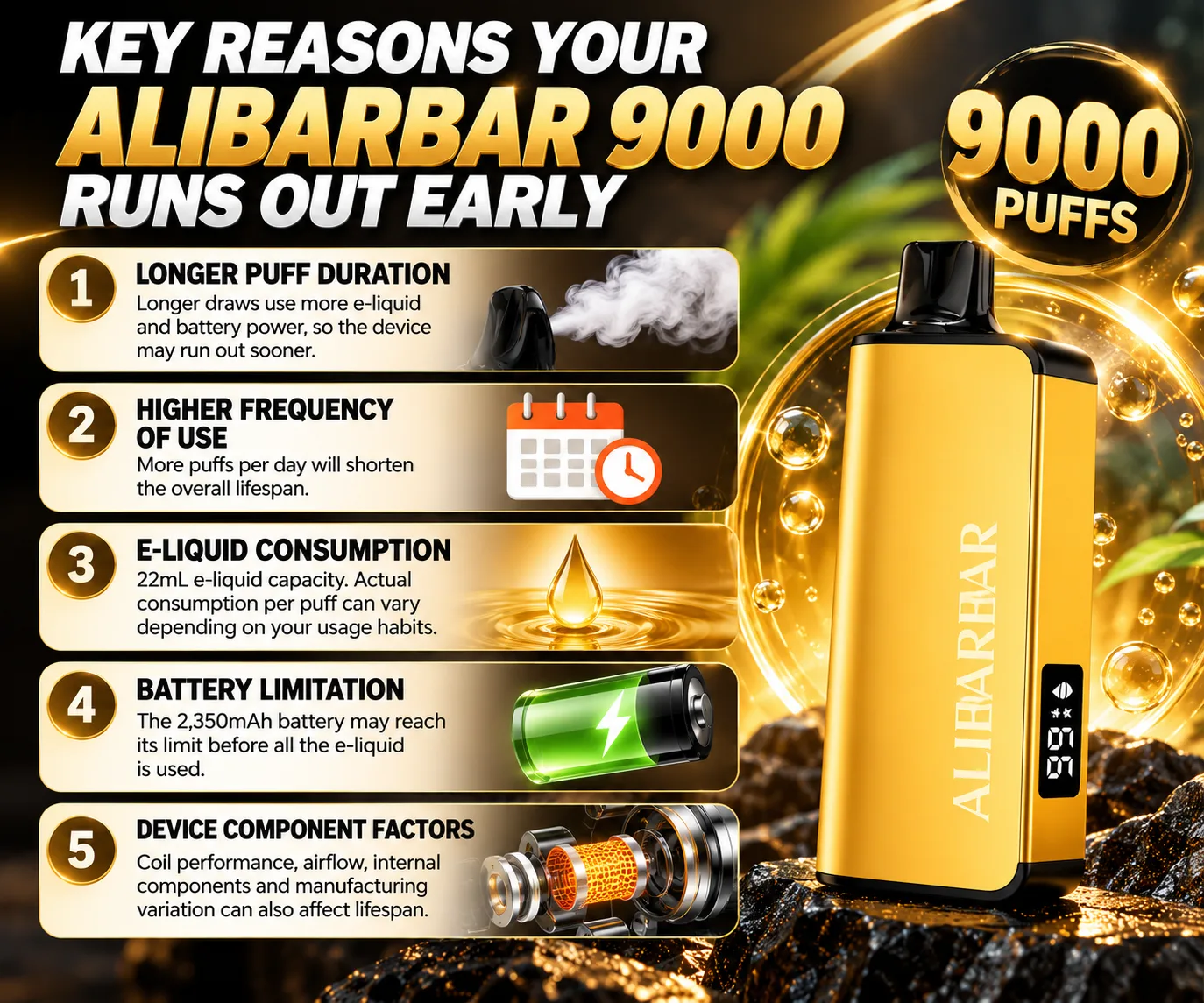
1. The 9,000-Puff Rating Is Not a Guaranteed Count
The first thing worth understanding is that 9,000 puffs is an advertised maximum, not a guaranteed number of draws.
Puff counts depend on the conditions used to measure them, including draw length, airflow volume and the point at which the device is considered depleted.
Without a published, model-specific test report, it's impossible to confirm exactly how the ALIBARBAR 9000's advertised rating was established.
That's why a printed puff count shouldn't be treated as a precise measurement of remaining device life.
2. Longer Puffs Can Consume More E-Liquid
One of the biggest differences between individual draws is duration.
Consider two hypothetical users:
Draw PatternDurationTotal Activation Time for 100 PuffsShort draws1 second100 secondsMedium draws3 seconds300 secondsLong draws5 seconds500 secondsSomeone taking 100 five-second draws keeps the heating element activated five times longer than someone taking 100 one-second draws.
At comparable operating power, longer activation generally means greater energy use and potentially higher liquid consumption.
This doesn't mean the device will necessarily run out five times faster. Actual consumption also depends on the coil, power delivery and liquid supply.
The key point: Two people can record the same number of puffs while consuming different amounts of e-liquid.
3. The Battery May Reach Its Limit First
The ALIBARBAR INGOT 9000 has been advertised with a 2,350 mAh battery, although this specification should be verified against the exact device version.
Battery capacity is only one part of the lifespan equation.
A device may stop functioning because of:
Battery depletion.
Voltage dropping below the operating threshold.
Internal connection failure.
Draw sensor malfunction.
Electronic control circuit faults.
If the device stops producing vapour, it doesn't automatically mean all the e-liquid has been consumed.
Likewise, a battery indicator cannot always provide a precise measurement of remaining usable battery capacity.
4. E-Liquid Capacity Doesn't Directly Equal Puff Count
Published ALIBARBAR INGOT 9000 specifications commonly state an advertised 22 mL e-liquid capacity.
But liquid capacity alone cannot establish the number of puffs a device will produce.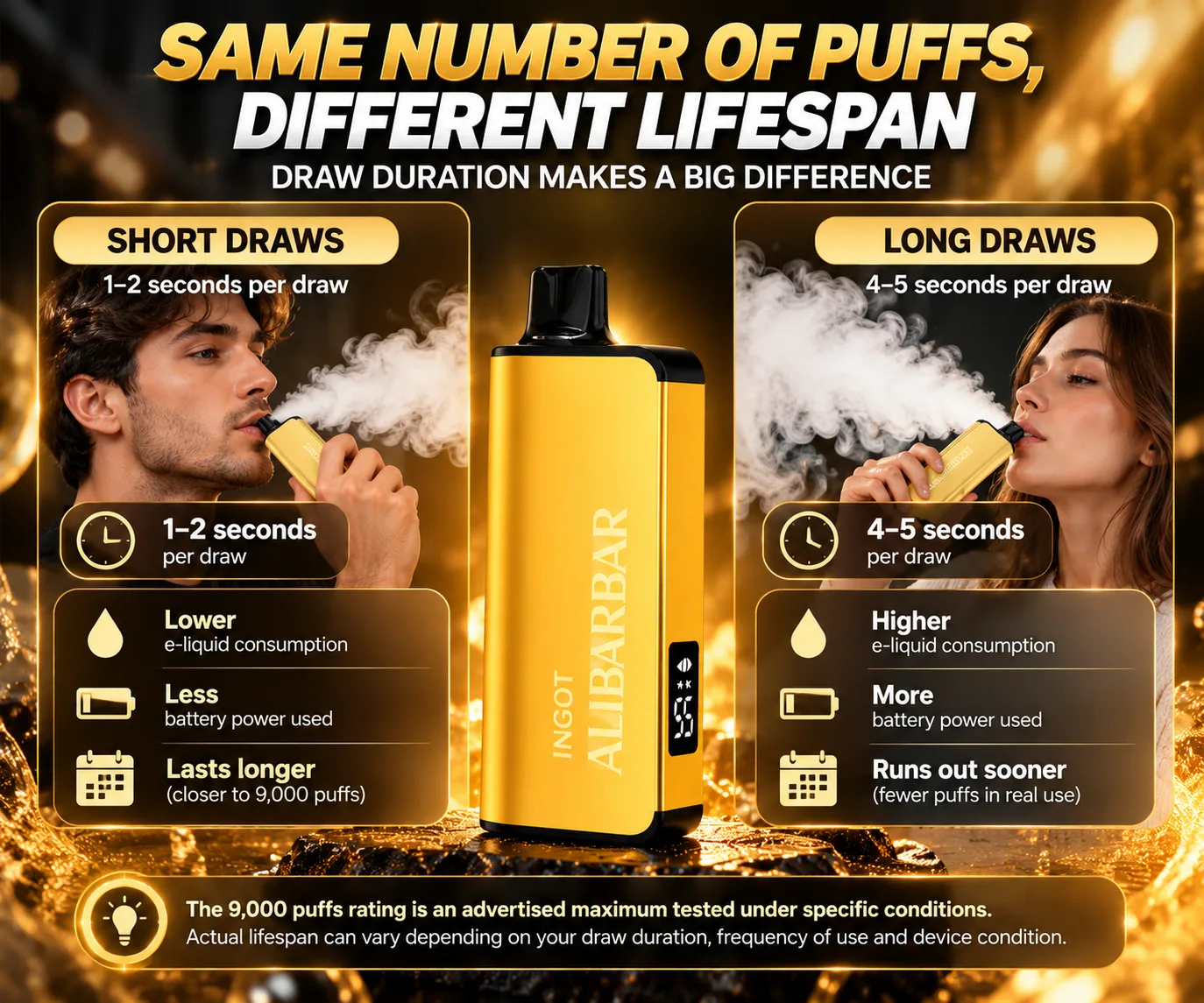
Actual liquid consumption depends on:
Heating power.
Coil design.
Puff duration.
Aerosol production per draw.
Liquid-delivery efficiency.
For illustration, dividing 22 mL by 9,000 gives approximately 0.00244 mL per puff, or 2.44 microlitres.
This is simply a mathematical average implied by the two advertised figures. It is not a verified measurement of ALIBARBAR 9000 consumption.
If actual consumption per draw is higher, the total number of possible draws will be lower.
5. Internal Components Can Fail Before the Device Is Empty
Sometimes an ALIBARBAR stops working early because of a fault rather than normal depletion.
Common possibilities include:
Draw sensor failure: The device may no longer detect activation correctly.
Heating element failure: The coil may stop functioning even when power is available.
Liquid-delivery problems: Internal wicking components may fail to supply liquid consistently.
Condensation or leakage: Moisture can interfere with airflow or electronic components.
Manufacturing variation: Component quality and assembly consistency can affect reliability.
These faults may produce symptoms that resemble an empty battery or depleted e-liquid reservoir.
6. How Can You Tell Why Your ALIBARBAR Stopped Early?
The following symptom guide can help distinguish possible causes.
SymptomPossible ExplanationNo response or indicator activityBattery or circuit faultNormal airflow but no vapourSensor, coil or power-delivery issueWeak vapour before stoppingLiquid-delivery or battery limitationGurgling noiseCondensation or internal liquid accumulationBurnt smellPotential overheating or inadequate liquid supplyVisible leakageReservoir or seal failureExcessive heatPossible battery or electrical hazardThese symptoms are not definitive diagnoses.
If a device leaks, overheats, swells or produces an unusual burning smell, stop using it. Avoid opening or modifying a sealed device.
7. Could a Counterfeit ALIBARBAR Have a Shorter Lifespan?
Counterfeit devices may differ from genuine products in battery quality, component reliability, liquid capacity and manufacturing consistency.
However, a shorter-than-advertised lifespan does not prove a device is counterfeit.
Authenticity should be assessed using multiple sources of evidence, including packaging details, product identifiers and legitimate manufacturer verification information.
QR codes alone may not be sufficient because counterfeit packaging can reproduce printed verification features.
8. Does the ALIBARBAR 9000 Display Show Exactly How Many Puffs Are Left?
Some ALIBARBAR INGOT 9000 versions feature indicators associated with battery or liquid status.
However, a status display should not automatically be interpreted as an exact remaining-puff counter.
An indicator may estimate remaining battery charge or liquid level using the device's internal electronics.
The accuracy of those estimates depends on the design and calibration of the particular model.
A display reading is not equivalent to physically measuring the remaining e-liquid or battery capacity.
Frequently Asked Questions
Is 9,000 Puffs a Guaranteed Lifespan?
No. The advertised rating is an upper-limit claim. Actual performance can vary with draw characteristics, operating conditions and device reliability.
Why Did My ALIBARBAR 9000 Stop Working After Only a Few Days?
Possible explanations include frequent or longer draws, battery depletion, liquid consumption or an internal fault. Calendar days alone cannot identify the cause.
Can the Battery Run Out Before the E-Liquid?
Yes. Battery and liquid capacity are separate operating constraints. Either may limit device operation.
Why Does My ALIBARBAR Show Liquid Remaining but Produce No Vapour?
Possible causes include sensor malfunction, heating-element failure, battery problems or an inaccurate liquid-level estimate.
Does a Burnt Taste Mean the Device Is Empty?
Not necessarily. A burnt taste can also indicate inadequate liquid delivery or overheating. Stop using the device if this occurs.
Can I Repair an ALIBARBAR That Stops Working Early?
Opening, puncturing or modifying a sealed vaping device can create electrical and lithium-ion battery hazards. A malfunctioning device should not be subjected to DIY internal repairs.
Final Thoughts
So, why does an ALIBARBAR 9000 run out before 9,000 puffs?
The answer is that puff count is influenced by more than the number of times a device is activated.
Longer draws, variations in e-liquid consumption, battery limitations and internal faults can all reduce the number of usable draws.
For Australian readers researching ALIBARBAR product specifications, the important distinction is between an advertised maximum puff count and independently verified real-world performance.
A device that stops early may have reached an operating limit or developed a fault. Without controlled testing, neither explanation should be assumed automatically.
Australian regulatory note: Disposable vapes are prohibited in Australia, and permitted therapeutic vaping goods are subject to strict pharmacy-supply requirements. Product specifications do not establish that a device is approved or lawfully supplied in Australia.